Is Arthur Fils behind schedule?
Hello !
Welcome to a new tennis post. For better visibility, I advise you to read it on a computer and on my website, if you are reading this from the newsletter, by clicking "View in browser" just above rather than directly from the email.
A few weeks ago, Arthur Fils won the Cincinnati Masters 1000, a huge result, and then lost in the very first round of the 2026 US Open. On social media, the usual verdict came fast: he's stalling, he should already be going deep at Grand Slams, he's late.
Then I came across this tweet from @vologe_tola
Il fallu 22 GC à Wawrinka pour atteindre les 1/4. Et 19 à Gilles Simon, 14 à Grosjean, 16 à Berdych, 14 à Dimitrov, 11 à Murray, 10 à Thiem, Del Potro et Ferrer, 8 à Federer.
— Merci Didier (@vologe_tola) September 1, 2026
Sauf quelques météorites (Sinner, Alcaraz, Nadal, Tsonga, Jodar…) le circuit est un lent apprentissage https://t.co/lmK7uJxk6H
In English, his point is this: apart from a handful of prodigies (Sinner, Alcaraz, Nadal, Tsonga, Jodar and a few others), most players needed a long run of majors before their first quarter-final. It took Wawrinka 22, Berdych 16, Murray 11, even Federer 8. The tour, he wrote, is a long apprenticeship.
I completely agreed with it. But I wanted to go beyond a handful of names and check the idea against the whole population of players. So I did what I always do: I opened RStudio and started digging.
The idea
The question is simple: is Arthur Fils actually behind, or does it just feel that way? To answer it, I needed a fair yardstick, not "what has he won" but "how long does it usually take?". The metric I settled on is deliberately blunt: the number of Grand Slams a player entered before reaching their first quarter-final. Fils has played 10 Grand Slams and his best result so far is a fourth round, so his counter still reads zero quarter-finals. The real question is where that places him in relation to everyone who ultimately reached that famous quarter-final.
The data
My first instinct was Jeff Sackmann's tennis_atp dataset, the usual reference for this kind of work. Bad luck: the files had been pulled from GitHub. I switched to TennisMyLife, which turned out to be a great fit: a Sackmann-compatible schema, coverage from 1968 to 2026, ATP identifiers, live updates, and an MIT licence (free to publish, just credit the source). One thing worth spelling out: why 1968? That year is the start of the Open Era, when the Grand Slams finally opened their draws to professionals. Before it, the majors were amateur-only and many of the best players in the world were shut out, so 1968 is both where the data begins and where modern Grand Slam tennis really starts.
One trap cost me a bit of time: the recent files mix in doubles matches, which inflates the Grand Slam count for today's players (a doubles specialist can pile up "appearances" that were never singles main draws). I de-duplicated on player by tournament before counting anything, keeping only each player's best result per event.
The approach
I restricted the field to the players who eventually reached at least one Grand Slam quarter-final, and for each of them I computed how many majors they had entered before that first breakthrough. That gives one number per player, and a whole population to compare Fils against.
But that 1968 start line hides a trap. Take Rod Laver: he was already a champion before the Open Era, yet the data only sees him from 1968 on, so it looks like he reached a quarter-final on his very first Grand Slam, when really we are just missing the start of his career. Every player active before 1968 is distorted the same way, pushed artificially far to the left (in mathematics, this is called left truncation. For Arthur Fils, however, it is a case of right censoring). The data itself cannot flag them, so it took a bit of manual checking, but I removed every player who had already played a major before 1968, keeping only careers I can see from the very beginning. That leaves 332 fully observed careers.
I then dropped Fils into that distribution as a marker, not as one of the 332 (he hasn't broken through yet) but at his current stage of 10 Grand Slams, "still in progress".
What the data shows
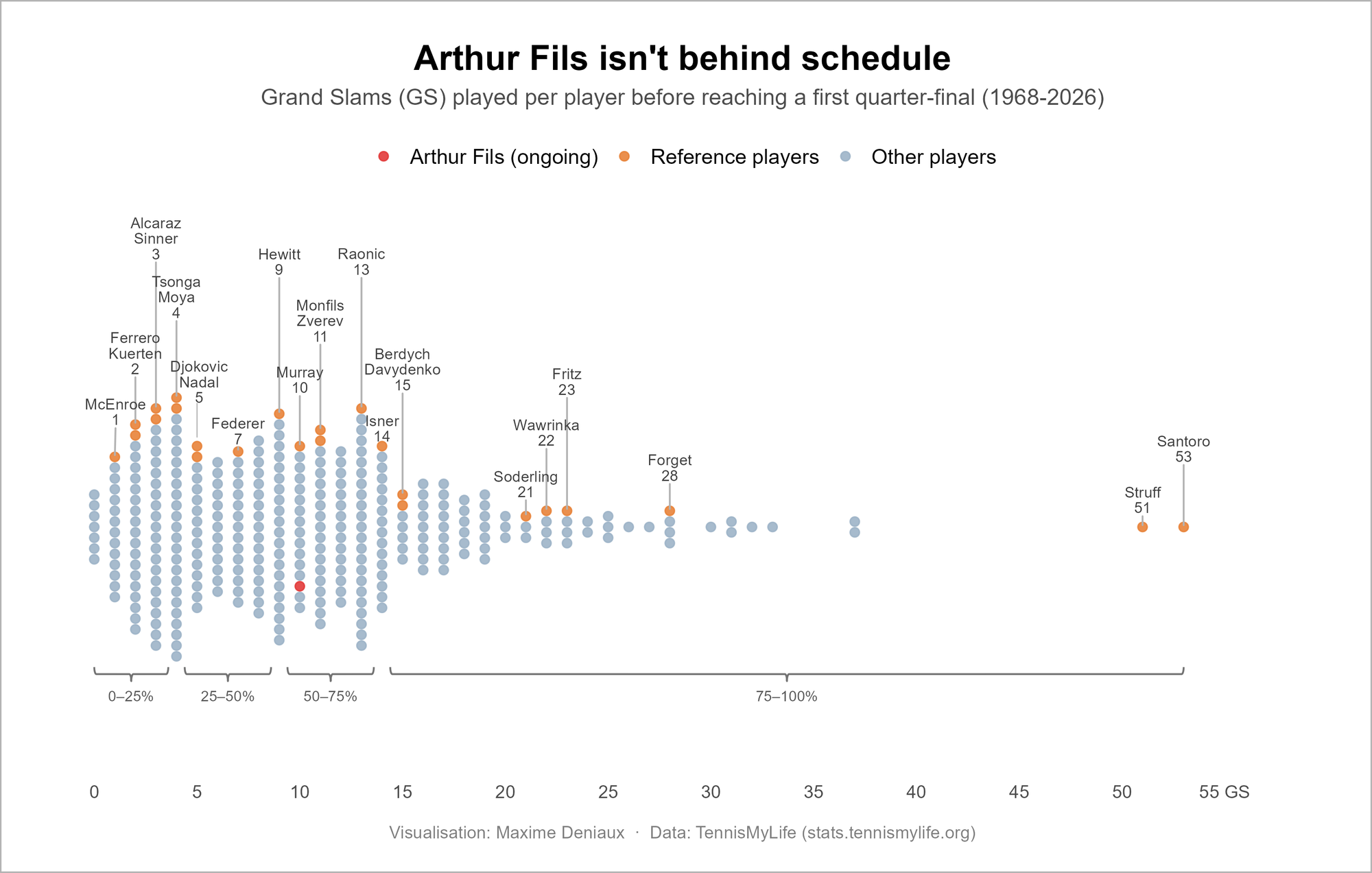
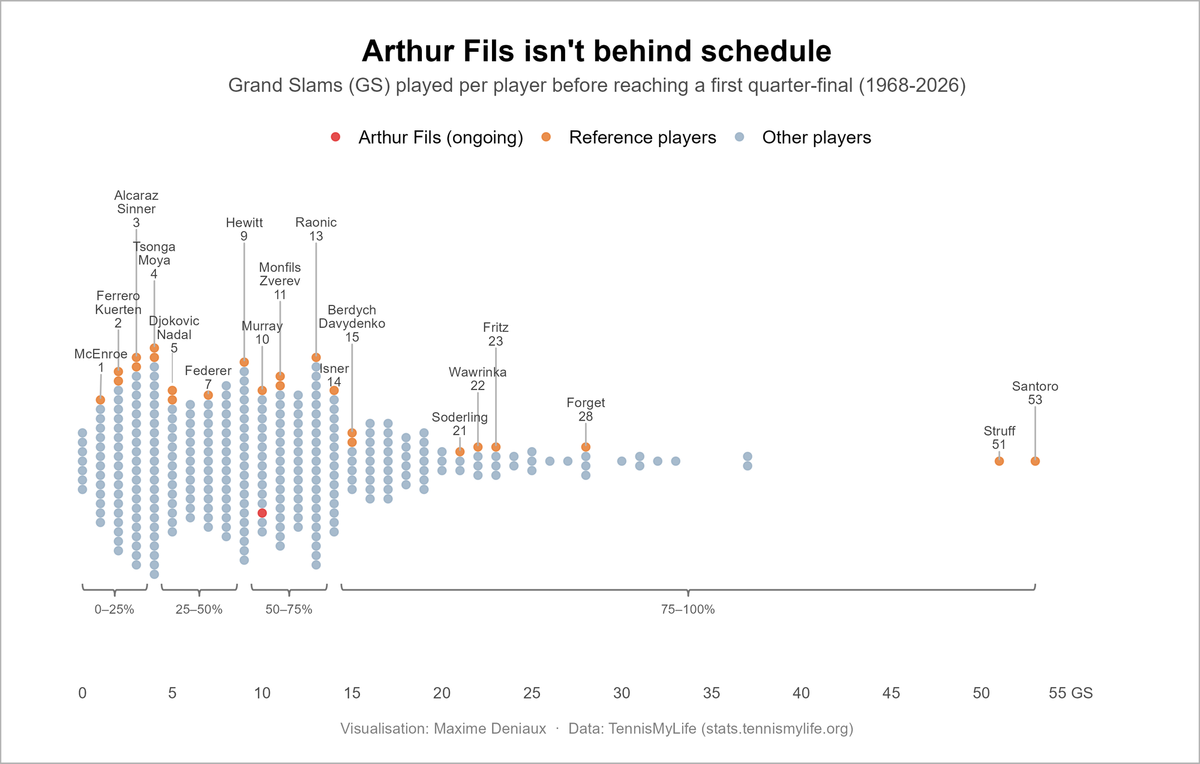
The first thing that jumps out is that there is no "normal" timeline. The cloud is spread all the way across the axis. The median sits at 9 Grand Slams, so half of all future quarter-finalists needed 9 or fewer, half needed more. Fils, at 10, lands essentially right on that median. Not early, not late: dead center.
And the tail on the right is long. Plenty of excellent careers were built on patience: Wawrinka needed 22 majors before his first quarter (and in the end, he won 3 Grand Slam titles!), Forget 28, Struff 51, and Fabrice Santoro a staggering 53. At the other end, the prodigies who broke through almost immediately, like Djokovic and Nadal at 5 or Federer at 7, are the exception, not the rule. Most of the players in orange who haven't been “truly great champions” (world No. 1, for example...) are positioned to the right of Fils, not to his left, which perfectly supports the argument put forward by @vologe_tola.
Put differently: at the exact stage Fils is at now, 10 Grand Slams without a quarter-final, about 48% of all future quarter-finalists still hadn't broken through either. His first-round exit at the US Open is noise. His breakthrough clock is running perfectly on time.
Why this dataviz
I've been thinking about what makes a dataviz worth publishing. For me this one ticks the boxes: it starts from a real, current debate (something I actually saw people argue about), it leans on a rich public dataset, and the answer isn't obvious before you look, since most people's gut feeling ("he's late") is simply wrong. It's also the kind of chart where the shape does the arguing for you: you don't need to trust my number, you can just see Fils sitting in the middle of a crowd that stretches all the way out to 53.
A last couple of caveats, in the spirit of full disclosure. Doubles specialists like Santoro inflate the extreme right of the distribution, so take the very last dots with a grain of salt.
Tools and methodology
Built entirely in R: tidyverse for wrangling, ggplot2 for the chart, ggrepel for the label placement, and ggbrace for the quartile braces under the cloud. The beeswarm itself is a manual dot-plot (one column per value, points stacked and centered), which let me pin specific players to the top of their column and drop Fils in as his own red marker. The braces split the field into quarters (0-25% up to 75-100%) with a fixed depth and curvature so they stay visually consistent despite very different widths.
Thanks for reading! I hope it was clear and you enjoyed it.
You will find the code below by clicking the github link button.
If you have any questions or remarks, I invite you to create an account (it's free) to write a comment, or simply to be notified of a new post in the future !
See you soon for new content 👋
 MaximeDeniaux
Comments ()